
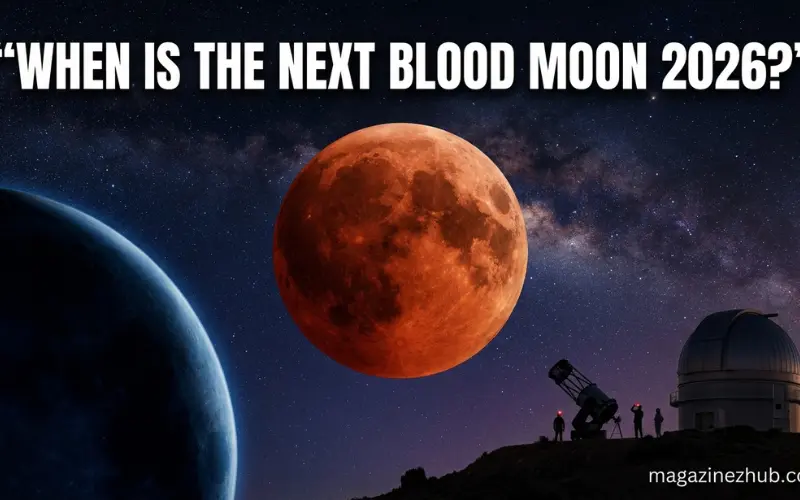
The next Blood Moon in 2026 refers to a total lunar eclipse where the Moon appears red due to Earth’s shadow blocking direct sunlight. The exact timing of a Blood Moon depends on lunar eclipse cycles, and in 2026, skywatchers can expect at least one total lunar eclipse event visible in certain regions of the world.
A Blood Moon is not actually a separate type of Moon—it is a total lunar eclipse phenomenon where sunlight passes through Earth’s atmosphere, scattering blue light and allowing red wavelengths to reach the Moon’s surface.
In this complete guide, you will learn the exact Blood Moon 2026 timing (where visible), scientific explanation, eclipse types, visibility map overview, safety tips, cultural meaning, and future lunar eclipse schedule in a simple and detailed way.
What Is a Blood Moon?
A Blood Moon occurs during a total lunar eclipse, when Earth comes directly between the Sun and the Moon. During this alignment, Earth blocks sunlight from reaching the Moon.
However, the Moon does not become completely dark. Instead, sunlight passes through Earth’s atmosphere, where shorter wavelengths (blue light) scatter away, and longer red wavelengths bend around Earth and reach the Moon.
This gives the Moon a deep red, orange, or copper color—known as a Blood Moon.
When Is the Next Blood Moon in 2026?
The next Blood Moon in 2026 will occur during a total lunar eclipse event scheduled in the global eclipse calendar.
While exact visibility depends on location, the 2026 lunar eclipse cycle includes a total eclipse event visible in parts of Asia, Australia, and the Pacific region.
For observers in South Asia (including Pakistan, India, and nearby regions), the eclipse may be partially or fully visible depending on local timing and moonrise conditions.
Key Point:
- A Blood Moon happens only during a total lunar eclipse phase
- It can last for several minutes to over an hour at peak totality
How Often Does a Blood Moon Occur?
Blood Moons do not happen every month because the Moon’s orbit is slightly tilted compared to Earth’s orbit around the Sun.
This means perfect alignment happens only a few times per year.
On average:
- Total lunar eclipses occur 2–3 times per year globally
- Full Blood Moon visibility in one location happens less frequently
Why Does the Moon Turn Red?
The red color during a Blood Moon is caused by a process called Rayleigh scattering.
When sunlight passes through Earth’s atmosphere:
- Blue light scatters in all directions
- Red light bends and travels through the atmosphere
- This red light reaches the Moon’s surface
The same process is responsible for red sunsets and sunrises.
Types of Lunar Eclipses
There are three main types of lunar eclipses:
Total Lunar Eclipse (Blood Moon)
The entire Moon passes into Earth’s shadow and turns red.
Partial Lunar Eclipse
Only part of the Moon enters Earth’s shadow.
Penumbral Lunar Eclipse
The Moon passes through the outer shadow, causing slight dimming.
Only total lunar eclipses create a true Blood Moon effect.
Where Will the 2026 Blood Moon Be Visible?
Visibility of the Blood Moon depends on geographic location and timing.
In general, lunar eclipses can be seen from:
- Asia (including South Asia)
- Australia
- Pacific regions
- Parts of Europe and Africa (depending on timing)
For Pakistan and surrounding regions, visibility will depend on whether the eclipse occurs during night-time hours locally.
How Long Does a Blood Moon Last?
A total lunar eclipse has different phases:
- Penumbral phase: faint shading begins
- Partial phase: shadow starts covering the Moon
- Total phase (Blood Moon): Moon turns red
The total “Blood Moon” phase can last:
- Around 30 minutes to 1.5 hours depending on the eclipse
How to Watch the Blood Moon Safely
Unlike solar eclipses, lunar eclipses are completely safe to watch with the naked eye.
You do not need:
- Special glasses
- Filters
- Protective equipment
Best viewing tips:
- Go to a dark area away from city lights
- Use binoculars for better detail
- Check local moonrise timing
- Use astronomy apps for live tracking
Scientific Importance of Blood Moon
Blood Moons are not just beautiful—they are scientifically valuable.
Astronomers study lunar eclipses to:
- Understand Earth’s atmosphere composition
- Study light scattering behavior
- Test space observation models
- Improve satellite calibration
Each eclipse provides valuable data for space research.
Cultural and Historical Meaning of Blood Moon
Throughout history, Blood Moons have been associated with myths, beliefs, and cultural interpretations.
Different civilizations viewed them as:
- Signs of change or transformation
- Celestial warnings
- Sacred astronomical events
Today, science explains the phenomenon clearly, but cultural interest remains strong worldwide.
Blood Moon vs Regular Full Moon
A normal full Moon appears bright white or yellow, while a Blood Moon appears red due to Earth’s shadow.
Key difference:
- Full Moon = direct sunlight reflection
- Blood Moon = sunlight filtered through Earth’s atmosphere
This makes Blood Moons rare and visually dramatic.
Future Lunar Eclipses After 2026
After 2026, several lunar eclipses will continue to occur in regular cycles.
Astronomers predict:
- Multiple partial lunar eclipses
- Occasional total lunar eclipses
- Varying visibility depending on region
Eclipse cycles follow predictable astronomical patterns known as Saros cycles.
Best Time and Place to Observe in 2026
To get the best viewing experience:
- Choose a location with clear skies
- Avoid light-polluted cities
- Check weather forecasts before the event
- Use high ground or open areas
Timing is crucial because totality lasts for a limited period.
Blood Moon Photography Tips
Capturing a Blood Moon requires simple techniques:
- Use a tripod for stability
- Use zoom lens or telescope if available
- Set long exposure settings
- Avoid camera shake
- Capture during peak totality for best red color
Even smartphones with night mode can capture decent images.
Blood Moon 2026 Eclipse Path Map Explanation
The visibility of a Blood Moon in 2026 will depend on the lunar eclipse path, which shows which parts of the Earth can see the eclipse at different stages.
During a total lunar eclipse, the Moon passes through Earth’s umbra (dark central shadow). Countries inside this visibility zone will see the full Blood Moon effect, while regions outside it may only see a partial eclipse or nothing at all.
In general, the eclipse visibility shifts across continents as the Earth rotates, making it a global but region-dependent event.
What Makes the 2026 Blood Moon Special?
The 2026 Blood Moon is considered special because of its global visibility window and timing in the Saros eclipse cycle. Some lunar eclipses last longer or appear deeper red depending on atmospheric conditions.
Factors that may make the 2026 event more visually striking include:
- Clear atmospheric conditions
- Low pollution levels
- High eclipse magnitude
- Optimal Earth-Moon-Sun alignment
These factors can intensify the red coloration, making the Moon appear darker and more dramatic than usual.
Atmospheric Conditions and Color Variations
Not all Blood Moons look the same. The shade of red can change depending on Earth’s atmosphere.
If the atmosphere contains more dust, pollution, or volcanic particles, the Moon may appear:
- Dark red
- Copper red
- Brownish red
If the atmosphere is clean, the Moon may appear:
- Bright orange
- Light red
- Golden red
This is why each Blood Moon looks slightly different even though the process is always the same.
See Aso:
Coolkingzone.com Full Website Overview and User Guide
FAQs
When is the next Blood Moon in 2026?
A total lunar eclipse in 2026 will create a Blood Moon visible in selected regions depending on timing.
Is Blood Moon dangerous?
No, it is completely safe to watch with naked eyes.
Why does the Moon turn red?
Because Earth’s atmosphere filters sunlight and allows red light to reach the Moon.
How long does a Blood Moon last?
The total phase can last from 30 minutes to over an hour.
Can everyone see the Blood Moon?
Visibility depends on your geographic location and weather conditions.
Conclusion
The next Blood Moon in 2026 will be a fascinating astronomical event that skywatchers around the world will look forward to. It is a natural phenomenon caused by Earth’s alignment between the Sun and Moon, creating a stunning red glow in the night sky.
Whether you are an astronomy enthusiast or a casual observer, this event offers a rare chance to witness one of nature’s most beautiful cosmic displays.
With proper timing and clear skies, the 2026 Blood Moon will be an unforgettable experience for millions of people around the world.
