
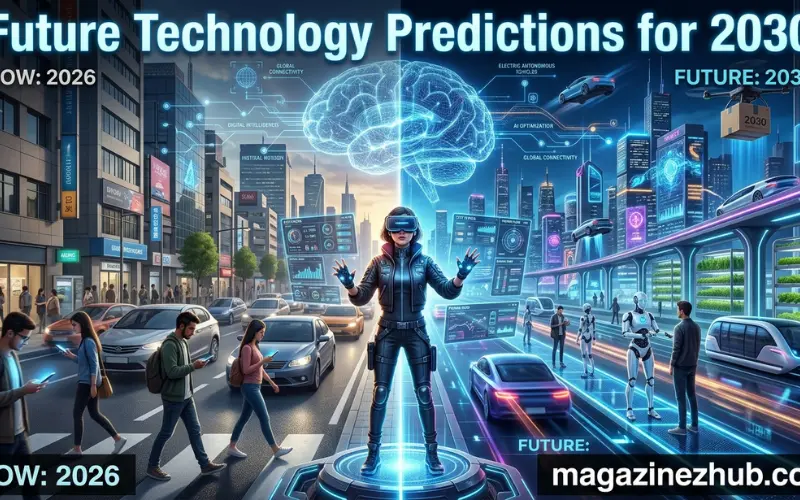
By 2030, technology will completely transform how humans live, work, learn, and interact with the world. Artificial intelligence will become deeply integrated into daily life, smart cities will expand globally, automation will replace many repetitive jobs, and healthcare, transportation, and communication will reach a level of advancement that feels almost science-fiction today. The future of 2030 is not just about faster devices or smarter apps—it is about a fully connected digital ecosystem where humans and machines work together seamlessly.
In this article, we will explore the most powerful and realistic future technology predictions for 2030, including artificial intelligence, robotics, quantum computing, space technology, biotechnology, and more. Each section is explained in simple language with deep insights so you can understand how the next technological era will shape your future.
Artificial Intelligence Will Become Human-Like
By 2030, artificial intelligence will no longer be limited to chatbots or simple automation tools. Instead, AI will evolve into highly intelligent systems capable of reasoning, decision-making, emotional understanding, and creative thinking. These advanced AI systems will assist in nearly every industry including education, healthcare, business, and entertainment.
AI assistants will act like personal digital partners that manage schedules, analyze problems, write content, design products, and even make business decisions. Unlike today’s AI, future systems will understand context deeply and respond more naturally, almost like human conversation.
Businesses will rely heavily on AI-driven decision-making systems that analyze massive amounts of data instantly. This will reduce human error and increase productivity at a global scale. However, it will also create debates about job displacement and ethical AI usage.
Hyper-Advanced Robotics in Everyday Life
Robotics technology will reach a stage where robots are no longer limited to factories. By 2030, robots will be present in homes, hospitals, schools, airports, and even public streets. These robots will perform tasks such as cleaning, cooking, security monitoring, elderly care, and delivery services.
Humanoid robots will become more realistic in movement and expression. They will be able to understand voice commands, recognize faces, and interact naturally with humans. In healthcare, robotic assistants will help doctors perform complex surgeries with extreme precision, reducing risks and improving recovery times.
Industries such as manufacturing, agriculture, and logistics will become almost fully automated, increasing efficiency but reducing the need for manual labor.
Self-Driving and Flying Vehicles
Transportation will undergo a massive transformation by 2030. Self-driving cars will become common in most developed cities, reducing traffic accidents caused by human error. These vehicles will communicate with each other using smart traffic systems, making transportation faster and safer.
Electric vehicles will dominate the market, replacing traditional fuel-based cars. Charging infrastructure will be faster and more widely available.
A more futuristic prediction is the rise of flying taxis and drone-based transport systems. These aerial vehicles will reduce traffic congestion in large cities and provide faster travel options for short distances. While still in early development today, by 2030, limited commercial use is highly possible.
Smart Cities and Fully Connected Living
Smart cities will become one of the biggest technological achievements of 2030. These cities will use sensors, AI systems, and IoT (Internet of Things) devices to manage traffic, energy consumption, security, and public services in real time.
Streetlights will adjust automatically based on traffic conditions. Waste management systems will optimize collection routes automatically. Buildings will become energy-efficient and self-regulating.
Citizens will experience a more connected lifestyle where everything—from transportation to healthcare—will be integrated into a single digital ecosystem. Governments will also use smart systems to improve decision-making and public safety.
Quantum Computing Revolution
Quantum computing will be one of the most powerful technological breakthroughs by 2030. Unlike traditional computers, quantum computers can process massive amounts of data simultaneously, solving complex problems in seconds that would take normal computers years.
This technology will revolutionize fields like medicine, cybersecurity, material science, and climate modeling. For example, scientists will be able to simulate new drugs and medical treatments much faster, potentially curing diseases that are currently difficult to treat.
However, quantum computing will also pose challenges in cybersecurity because it may break current encryption systems, forcing the development of new security standards.
Advanced Healthcare and Biotechnology
Healthcare in 2030 will be completely transformed by biotechnology and AI-driven systems. Diseases will be detected earlier through wearable devices that continuously monitor body health in real time.
Genetic engineering will allow doctors to treat or even prevent certain diseases before they develop. Personalized medicine will become common, where treatments are customized based on a person’s DNA.
Robotic surgeries, AI diagnosis systems, and smart health monitoring tools will significantly improve survival rates and reduce medical costs. Human lifespan is also expected to increase due to these advancements.
Virtual Reality and the Rise of the Metaverse
By 2030, virtual reality (VR) and augmented reality (AR) will become a part of everyday life. The concept of the metaverse—a fully digital virtual world—will expand into education, work, entertainment, and social interaction.
Students will attend virtual classrooms, employees will work in digital offices, and people will attend concerts, meetings, and events in virtual environments without leaving their homes.
VR devices will become lighter, cheaper, and more advanced, offering realistic sensory experiences. This will change the way humans interact with digital content forever.
Space Exploration and Colonization Efforts
Space technology will take a huge leap by 2030. Private companies and governments will work together to establish permanent bases on the Moon and possibly begin early missions to Mars.
Reusable rockets will reduce the cost of space travel, making exploration more frequent. Satellites will also play a major role in global internet coverage, climate monitoring, and communication systems.
Space tourism may become a luxury industry, allowing wealthy individuals to experience space travel for short periods.
Internet of Things (IoT) Everywhere
The Internet of Things will expand dramatically by 2030. Every device—from refrigerators to cars to wearable devices—will be connected to the internet and communicate with each other.
Homes will become fully automated, where lights, security systems, temperature, and appliances will adjust automatically based on user behavior. This will improve comfort, efficiency, and energy savings.
However, increased connectivity will also raise concerns about data privacy and cybersecurity.
Renewable Energy and Green Technology
Climate change will push the world toward clean and renewable energy sources by 2030. Solar, wind, and hydrogen energy will become dominant in many countries.
Electric grids will become smarter and more efficient. Energy storage technology will improve, allowing renewable energy to be used even when the sun is not shining or wind is not blowing.
Green technology will also focus on reducing pollution, recycling waste efficiently, and creating sustainable cities for future generations.
AI in Education Systems
Education will become highly personalized by 2030. AI-powered learning platforms will analyze student performance and create custom learning paths for each individual.
Students will learn through interactive simulations, VR classrooms, and real-time feedback systems. Traditional textbooks may become less common, replaced by digital and AI-based learning tools.
Teachers will act more like mentors while AI handles repetitive tasks like grading and content delivery.
Cybersecurity and Digital Protection Challenges
As technology grows, cybersecurity threats will also increase. By 2030, protecting digital data will become one of the most important global priorities.
Advanced encryption, AI-based security systems, and biometric authentication will be widely used to protect personal and corporate data. Cybersecurity experts will play a critical role in defending systems from hacking and digital attacks.
The Future of Jobs and Work
The job market in 2030 will look very different. Many traditional jobs will be automated, but new jobs will also emerge in AI development, robotics, data science, cybersecurity, and digital marketing.
Remote work will become the global standard. People will work from anywhere using digital platforms and virtual offices. Freelancing and online businesses will continue to grow rapidly.
Skills like creativity, problem-solving, and digital literacy will become more important than memorization or routine tasks.
Human Enhancement Technology
By 2030, technology may also enhance human abilities. Wearable devices, brain-computer interfaces, and smart implants could improve memory, communication, and physical performance.
While this technology is still developing, it could redefine what it means to be human in the future.
See Also:
10 Profitable Home Based Business Ideas for Students
FAQs
What is the biggest technology trend for 2030?
Artificial intelligence and automation are expected to be the biggest technological trends shaping all industries.
Will AI replace human jobs by 2030?
AI will replace some repetitive jobs, but it will also create new career opportunities in advanced fields.
How will education change in 2030?
Education will become digital, personalized, and AI-driven with VR and interactive learning tools.
Will self-driving cars be common by 2030?
Yes, self-driving vehicles are expected to become common in many developed cities.
What is the future of space technology?
Space exploration will expand with Moon bases, Mars missions, and space tourism development.
Conclusion
The world of 2030 will be powered by intelligent systems, automation, and advanced digital technologies. Artificial intelligence, robotics, quantum computing, and biotechnology will reshape every part of human life.
While these changes bring enormous opportunities, they also require responsibility, ethical thinking, and adaptation. The future belongs to those who learn, evolve, and embrace new technologies early.
One thing is clear: 2030 will not just be an upgrade of today—it will be a completely new digital era of human civilization.
